invito
invito

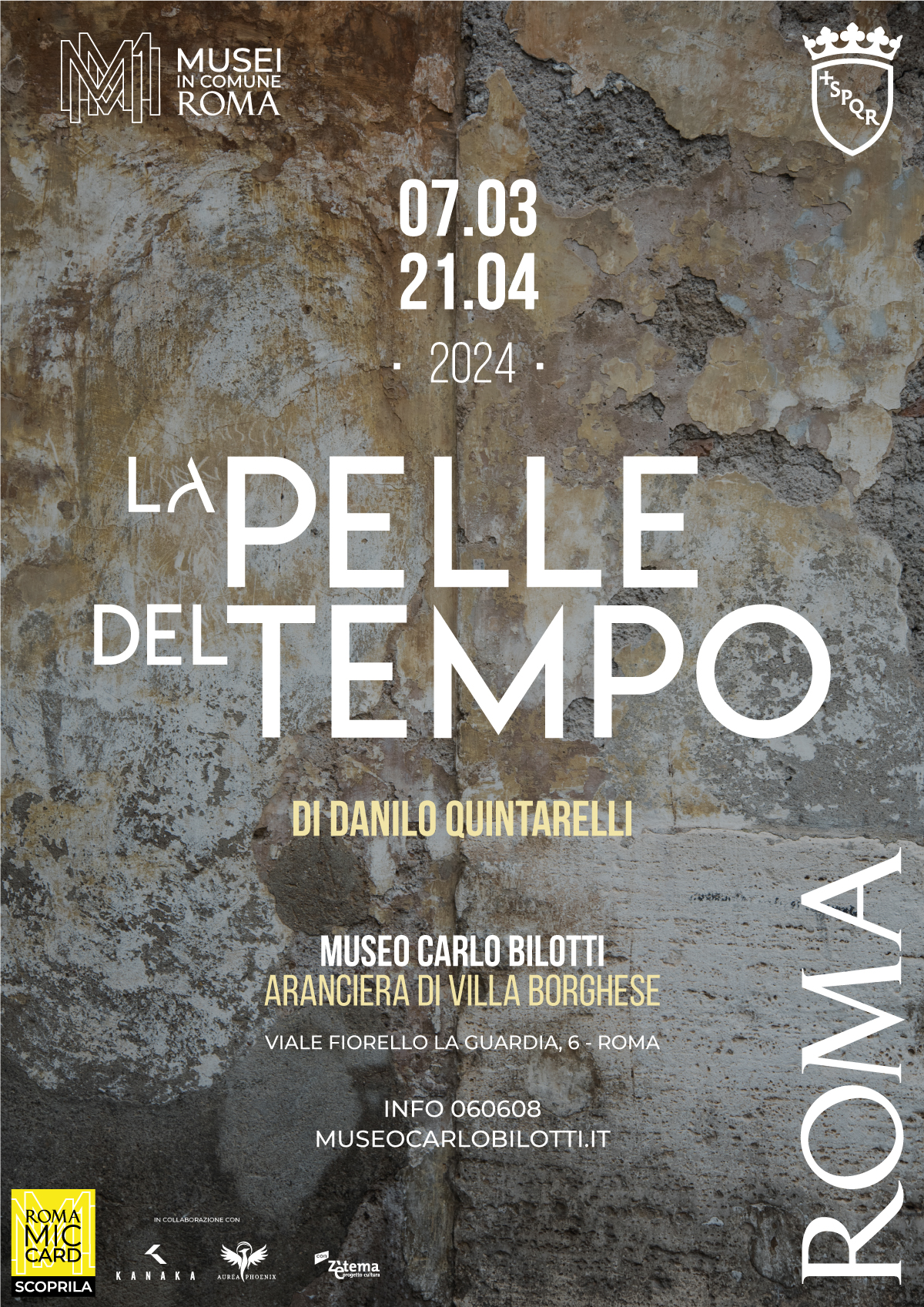
The Skin of Time


07/03 - 21/04/2024
Museum Carlo Bilotti Aranciera di Villa Borghese

The project traces the historical identity and transformations of the Villa Borghese Orangery building through a series of paintings that trace the overlapping of the wall surfaces, the "skin" of the architectural structure, interpreting the ages of its life.

The numerous transformations undergone by the palace over the centuries are recalled through the stratification of different pigments on canvas, while the materiality and tactility of the plaster is rendered through the use of papers and glues. Danilo Quintarelli, born in Avellino in 1989, has developed his own particular pictorial research focused on abandoning the form dictated by reason to rediscover unconscious forms of communication.

By Andrea Guastella.
INFO

The Skin of Time


07/03 - 21/04/2024
Museum Carlo Bilotti Aranciera di Villa Borghese

The project traces the historical identity and transformations of the Villa Borghese Orangery building through a series of paintings that trace the overlapping of the wall surfaces, the "skin" of the architectural structure, interpreting the ages of its life.

The numerous transformations undergone by the palace over the centuries are recalled through the stratification of different pigments on canvas, while the materiality and tactility of the plaster is rendered through the use of papers and glues. Danilo Quintarelli, born in Avellino in 1989, has developed his own particular pictorial research focused on abandoning the form dictated by reason to rediscover unconscious forms of communication.
By Andrea Guastella.
INFO

Without skin, there is no body. This plastic and delicate organ identifies us, tracing our boundaries in space. As David Le Breton wrote, "the skin embodies the person, distinguishing them from others; its texture, color, scars, and peculiarities (such as moles, for example) create a unique landscape." This landscape changes over time. Subjected to the challenges of age and the environment in which we live, the skin is the protagonist of an invisible metamorphosis, at least as irreversible and constant as it is unseen to the naked eye. Similar to an archive, it preserves traces of personal history; "it is like a palimpsest," Le Breton continues, "of which only the individual possesses the cipher." And that's not all: by providing the psychic apparatus with "constitutive representations of the Self and its functions" (Didier Azieu, "The Ego-Skin"), it is thanks to the skin that consciousness becomes flesh, rooted in a body.

On one hand, the skin is a barrier, a fortified frontier that protects us from self-destructive impulses and external assaults; on the other hand, by wrinkling, it takes on the role of consciousness, forcing us to perceive ourselves for what we are: fragile, limited, contingent beings. Either way, if the relationship with the world is a matter of skin, it's not surprising that Danilo Quintarelli, in his exploration of the transformations of the Aranciera di Villa Borghese, the palace currently housing the Carlo Bilotti Museum in Rome, has decided to focus more on the imposing structures but on the layers of plaster on the walls: these are precisely "The Skin of Time," the tangible memory of the building's past, from its glorious history to the ruins of war.

Its state, its transitory condition, is read in backlight in the artist's paintings, which do not aim for an objective representation of this or that physical detail; they are informal works in which the abstraction of lines and the dominance of color allude to an "other" interior, to that primordial component silenced by human interventions. Not by chance, the spaces that have most captivated Danilo are the lower levels of the palace, an area not open to visitors that has undergone few changes and thus shows, on its solid stones, a native energy.

Dusty, rough, scratched – the dominant red hue recalls coagulated blood – the overlapping colors of the painter are invitations to delve deeper; an exploration that, in the video created in collaboration with video artist Andrea Maioli (Kanaka Studio), becomes an airy projection into the future: space converts into time, surpassing every artificial construct. After all, as Didi-Hubermann argued in his commentary on Balzac's "The Unknown Masterpiece," art, to gain a "body," will have to boast "the interstitial virtue of the skin." It must transform into a "living, porous, irrigated, warm" surface. It must be substantial and liquid, mutable and frayed. It must conceal, in the abyss of the "Informe," the levity of the Absolute.
By Andrea Guastella

Without skin, there is no body. This plastic and delicate organ identifies us, tracing our boundaries in space. As David Le Breton wrote, "the skin embodies the person, distinguishing them from others; its texture, color, scars, and peculiarities (such as moles, for example) create a unique landscape." This landscape changes over time. Subjected to the challenges of age and the environment in which we live, the skin is the protagonist of an invisible metamorphosis, at least as irreversible and constant as it is unseen to the naked eye. Similar to an archive, it preserves traces of personal history; "it is like a palimpsest," Le Breton continues, "of which only the individual possesses the cipher." And that's not all: by providing the psychic apparatus with "constitutive representations of the Self and its functions" (Didier Azieu, "The Ego-Skin"), it is thanks to the skin that consciousness becomes flesh, rooted in a body.

On one hand, the skin is a barrier, a fortified frontier that protects us from self-destructive impulses and external assaults; on the other hand, by wrinkling, it takes on the role of consciousness, forcing us to perceive ourselves for what we are: fragile, limited, contingent beings. Either way, if the relationship with the world is a matter of skin, it's not surprising that Danilo Quintarelli, in his exploration of the transformations of the Aranciera di Villa Borghese, the palace currently housing the Carlo Bilotti Museum in Rome, has decided to focus more on the imposing structures but on the layers of plaster on the walls: these are precisely "The Skin of Time," the tangible memory of the building's past, from its glorious history to the ruins of war.

Its state, its transitory condition, is read in backlight in the artist's paintings, which do not aim for an objective representation of this or that physical detail; they are informal works in which the abstraction of lines and the dominance of color allude to an "other" interior, to that primordial component silenced by human interventions. Not by chance, the spaces that have most captivated Danilo are the lower levels of the palace, an area not open to visitors that has undergone few changes and thus shows, on its solid stones, a native energy.

Dusty, rough, scratched – the dominant red hue recalls coagulated blood – the overlapping colors of the painter are invitations to delve deeper; an exploration that, in the video created in collaboration with video artist Andrea Maioli (Kanaka Studio), becomes an airy projection into the future: space converts into time, surpassing every artificial construct. After all, as Didi-Hubermann argued in his commentary on Balzac's "The Unknown Masterpiece," art, to gain a "body," will have to boast "the interstitial virtue of the skin." It must transform into a "living, porous, irrigated, warm" surface. It must be substantial and liquid, mutable and frayed. It must conceal, in the abyss of the "Informe," the levity of the Absolute.
By Andrea Guastella

Interview with the artist Danilo Quintarelli


Investigator of the Unconscious At the edge of his personal exhibition "La pelle del tempo" at the Carlo Bilotti Museum in Rome, we meet Danilo Quintarelli, an investigator of the unconscious. The artist from Avellino, but adopted by Rome, conceived the exhibition as a true installation: a suspended action between reality and virtuality where each element invites reflection on the past and future of the palace hosting the exhibition. In "La pelle del tempo," the numerous transformations undergone by the Aranciera di Villa Borghese over the centuries are evoked by a series of paintings that trace the overlaps of the architectural structure's surfaces, the "skin" of the building, and by a video created in collaboration with video artist Andrea Maioli (Kanaka Studio). The video, based on some photos by Quintarelli, retraces the surreal evolutions of a cluster of colors.

Let's talk a bit about your origins, your hometown. I was born in Avellino, a city where a very slow approach to everyday life is preserved, a reflective calm that one must be inclined to and, above all, learn to manage. This dimension of waiting can be a stimulus, giving you that spark to shape your ambitions, or it can engulf you and keep you chained to the dampness of your anxieties and fears.

When and how did you start dedicating yourself to art? When I was in high school, a classmate involved me in his writing activities, sparking my passion. I started with drawings and sketches of lettering, then moved on to murals. I can't say I was a top-notch "street" artist; I didn't commit enough, but it was through writing that I understood how powerful art could be in its therapeutic and social aspects. During the early years of university, there was a "creative halt," during which my interests shifted to photography. After studying engineering, I enrolled at the Academy of Fine Arts in Naples, where I finally approached photography seriously and systematically, gathering the theoretical and conceptual elements that are the basis of my current artistic research.

An artist is always an observer. Have there been "apparitions" that radically changed your worldview? Absolutely yes! You should know that, in Avellino, I lived on the top floor of a building suffering from roof leaks, resulting in large mold stains covering the ceiling. During my childhood and adolescence, I spent hours observing those stains and getting lost in the infinite worlds they offered. I sought familiar images, characters from an intricate story, or simply amusing figures. I was always fascinated by our brain's tendency to associate indefinite shapes with images from our experience. I delved into these topics extensively during my academic studies in Form Psychology and Gestalt Theory.

You unknowingly followed Leonardo's lesson, inviting the painter to look at "various walls stained with various stains or at stones of various mixtures." How has this "Leonardesque" way of looking influenced your approach to the world? To this day, when I look at stains, holes, cracks, and erosions on walls, I seek the characters and settings of my stories. This "Leonardesque" way of looking has probably influenced my approach to the world and my consideration of it.

Art is also a dialogue with other artists. Are there any "appearances" that have particularly influenced your worldview? The first that come to mind are all the Surrealists, Alberto Burri, Antoine D'Agata, Francis Bacon, and Mark Rothko. Each of them has influenced my approach in some way. Surrealist thinking certainly sparked my interest in the world of the irrational and the unconscious: to this day, I write using the surrealist technique of automatic writing. Antoine D'Agata and Francis Bacon share an aesthetic rooted in human miseries, a element very close to my photography, which, not coincidentally, resembles the work of these two artists despite having very different conceptual foundations. Alberto Burri, for the materiality of his works and the use of poor materials, has clearly guided my research. And what about Rothko, who perhaps more than anyone else encouraged me. When I studied Rothko, I discovered that we shared the same conception of artwork: it is the threshold that allows those who approach it to access a higher dimension, where masks fall and sincerity reigns.

A common denominator among seemingly different and irreconcilable personalities could be the interest in the unconscious attributed to the surrealist influence. Drawing the lines of a figure can confine its meaning within our rational boundaries. The figures in my paintings are characters without contours, whose meaning knows no limits. Is there an exhibition you visited that you remember with particular intensity? Among the events that have left a mark on me, there is certainly an exhibition by the photographer Luciano D'Alessandro. The exhibition was held in the Bourbon Prison, a historic structure in my hometown. I remember walking in the courtyard surrounded by young photographers, or aspiring ones, who were competing to have the most technological and luxurious camera; in other words, they showed off with little substance. I distinctly remember the discomfort I felt being there, surrounded by so much superficiality. What caught my attention was an elderly gentleman sitting on a bench who, with great elegance and simplicity, chatted with a young girl; that elderly person was Luciano D'Alessandro. At that moment, it became clear to me that true greatness lies in humility.

The thin line between life and art, which is not your only occupation. Could you describe your typical day? My working life is divided between two worlds: philately and art. Currently, I collaborate with various companies where I manage the technical aspects related to the cataloging and evaluation of materials destined for sale. A job where precision and knowledge are everything. This reality inevitably clashes with my artistic activity, which is based on imprecision and unpredictability. I am a perfectionist, and my approach to art is a shock therapy to keep constant pursuit of a perfection that exists only in my mind. I find myself working during the day with rationality and at night with instinct.

Do you think your "scientific" interest in philately has influenced your artistic work in the opposite direction? Philately and art are two elements that I have carried with me since I can remember; they have shaped and determined each other, much like the layers of pigment that make up my paintings: establishing the boundary between them is often a desperate endeavor.

Do you have any particular rituals when you photograph or paint? When I paint, there's something I love to do: after each "step," I hang the painting on the wall, take a small chair, position it about three meters from the wall, sit down, and stop to observe. I stay there for hours, doing what I did as a child when, in the mold, I looked for the characters of my stories. I lose myself in other dimensions, then return to the chair and start working again.

What is your relationship with the unexpected and with error? The concept of "error" is a construct linked to the concepts of "right" and "wrong" and has value only in a rational dimension. In an approach like mine, there can be an error only when I fall into the trap of reasoning, passing judgment on what I am doing. The most challenging part of my work is accepting what comes without expressing a judgment.

Your works, as Penelope Filacchione wrote in reference to "Morfogenesi," your penultimate exhibition, "seem to develop on their own, almost without

the intervention of the artist, who becomes part of the process by initiating it with a few measured actions and then carefully guiding its development." I assume you fully agree with this interpretation. Absolutely yes. In the process I use, the artist's only task is to follow everything as it unfolds and flows, being very careful not to alter what happens rationally.

But how do you understand, in this context of perpetual becoming, when a work is finished? I realize that the question arises spontaneously: in a process that wants to exclude rationality, how do you "decide" when to stop? The overlapping of different layers of pigment implies, at each step, the fateful question: is it time? Each overlap "erases" or alters what had excited me a few minutes earlier and could have been a convincing result. I confess that it is not always easy to move on to the next "layer," but this is also part of the process, and I have to accept it. The work itself tells me when to stop: compositional balance is the element that marks the final layer.

In your painting, as Filacchione further notes, "infinite layers of paper, pigments, water, glue, placed on the canvas with long-considered actions, create delicate passages of planes, shades, abstract forms." Can you tell me about the physicality in your work? First of all, I want to tell you that it is a job where you get your hands dirty a lot, and not only that! Using large quantities of powdered pigments, I have to be extremely careful not to inhale them; so, I wear a mask with specific filters. It's a very slow and meticulous process, and by meticulous, I mean that it proceeds in very small steps. The canvases are mistreated, and the surfaces are constantly cracked or torn. You enter into a very close relationship with the work, which literally takes shape in your hands without you having the opportunity to decide what the final result will be: an "automatic" morphogenesis "cared for" by the artist.

Informal art, which your painting is inspired by, developed in a world of ruins, devastated by war. A world, if you look closely, not too different from the one we live in. War is a terrible event that is too easily becoming routine. What scares me the most is the dehumanization of people. A world without empathy and humanity is a finished world. As I see it, people are too "distracted," and this distraction is distancing them from themselves, leading them to lose familiarity with their own feelings. And this is where art gains an educational value. The approach to the work that I envision stimulates this aspect: it invites the viewer to take a journey into their unconscious, finding themselves in close contact with their emotions. In that place, there is no distraction: there is only you and everything that you usually don't even tell yourself.

Do you think artists can positively impact reality? We are moving rapidly toward a world dominated by Artificial Intelligence in which people are destined to lose more and more of their empathic faculties and manual skills: technology is no longer at the service of man, but man is at the service of technology. Art, by forcing you to deal with matter and feeling, represents a lifesaver - one of the last remaining ones - for future generations.

In what sense is the work of art, as you stated in an interview with Elisa Giammarino and Veronica Di Furia, a "safe place" for you? My research is primarily a personal journey on the winding road to self-discovery. More generally, I see my work as a mission whose goal is to give, to those who want to take a path similar to mine, the key to a "different" approach to art, where the viewer, through the work, generates meaning. A projective and at the same time introspective approach through which it is truly possible to investigate one's unconscious. Like in a daydream, in my works, the viewer is suspended in a bubble of intimacy where there is no judgment, and everything flows freely. A safe place.

In your "journey," you moved from photography to painting. Will the next step be video, as implied by the work done collaboratively with Andrea Maioli of Kanaka Studio for "La pelle del tempo"? Video art is a world I explored only during my academic period but one on which I have often reflected. The potential of video is enormous; however, I really don't know how to use it to produce an "instinctive" work. Whether one likes it or not, you find yourself dealing with filming, editing, lights, and many other actions that cannot be completely detached from rationality. But... never say never!

I'm heading towards the conclusion. What is your attitude towards the spiritual, the transcendent? Spirituality is the pivot around which everything revolves and acquires value. The artistic process itself is, for me, a spiritual advent, capable of elevating me and putting me in touch with that part of me closest to the divine.

What do you expect from the future? To continue my projects, making them increasingly significant and important. I would like to exhibit abroad to make my vision of art known and disseminated as much as possible. I am open to all the infinite possibilities that the future holds for me.
By Andrea Guastella.

Interview with the artist Danilo Quintarelli


Investigator of the Unconscious At the edge of his personal exhibition "La pelle del tempo" at the Carlo Bilotti Museum in Rome, we meet Danilo Quintarelli, an investigator of the unconscious. The artist from Avellino, but adopted by Rome, conceived the exhibition as a true installation: a suspended action between reality and virtuality where each element invites reflection on the past and future of the palace hosting the exhibition. In "La pelle del tempo," the numerous transformations undergone by the Aranciera di Villa Borghese over the centuries are evoked by a series of paintings that trace the overlaps of the architectural structure's surfaces, the "skin" of the building, and by a video created in collaboration with video artist Andrea Maioli (Kanaka Studio). The video, based on some photos by Quintarelli, retraces the surreal evolutions of a cluster of colors.

Let's talk a bit about your origins, your hometown. I was born in Avellino, a city where a very slow approach to everyday life is preserved, a reflective calm that one must be inclined to and, above all, learn to manage. This dimension of waiting can be a stimulus, giving you that spark to shape your ambitions, or it can engulf you and keep you chained to the dampness of your anxieties and fears.

When and how did you start dedicating yourself to art? When I was in high school, a classmate involved me in his writing activities, sparking my passion. I started with drawings and sketches of lettering, then moved on to murals. I can't say I was a top-notch "street" artist; I didn't commit enough, but it was through writing that I understood how powerful art could be in its therapeutic and social aspects. During the early years of university, there was a "creative halt," during which my interests shifted to photography. After studying engineering, I enrolled at the Academy of Fine Arts in Naples, where I finally approached photography seriously and systematically, gathering the theoretical and conceptual elements that are the basis of my current artistic research.

An artist is always an observer. Have there been "apparitions" that radically changed your worldview? Absolutely yes! You should know that, in Avellino, I lived on the top floor of a building suffering from roof leaks, resulting in large mold stains covering the ceiling. During my childhood and adolescence, I spent hours observing those stains and getting lost in the infinite worlds they offered. I sought familiar images, characters from an intricate story, or simply amusing figures. I was always fascinated by our brain's tendency to associate indefinite shapes with images from our experience. I delved into these topics extensively during my academic studies in Form Psychology and Gestalt Theory.

You unknowingly followed Leonardo's lesson, inviting the painter to look at "various walls stained with various stains or at stones of various mixtures." How has this "Leonardesque" way of looking influenced your approach to the world? To this day, when I look at stains, holes, cracks, and erosions on walls, I seek the characters and settings of my stories. This "Leonardesque" way of looking has probably influenced my approach to the world and my consideration of it.

Art is also a dialogue with other artists. Are there any "appearances" that have particularly influenced your worldview? The first that come to mind are all the Surrealists, Alberto Burri, Antoine D'Agata, Francis Bacon, and Mark Rothko. Each of them has influenced my approach in some way. Surrealist thinking certainly sparked my interest in the world of the irrational and the unconscious: to this day, I write using the surrealist technique of automatic writing. Antoine D'Agata and Francis Bacon share an aesthetic rooted in human miseries, a element very close to my photography, which, not coincidentally, resembles the work of these two artists despite having very different conceptual foundations. Alberto Burri, for the materiality of his works and the use of poor materials, has clearly guided my research. And what about Rothko, who perhaps more than anyone else encouraged me. When I studied Rothko, I discovered that we shared the same conception of artwork: it is the threshold that allows those who approach it to access a higher dimension, where masks fall and sincerity reigns.

A common denominator among seemingly different and irreconcilable personalities could be the interest in the unconscious attributed to the surrealist influence. Drawing the lines of a figure can confine its meaning within our rational boundaries. The figures in my paintings are characters without contours, whose meaning knows no limits. Is there an exhibition you visited that you remember with particular intensity? Among the events that have left a mark on me, there is certainly an exhibition by the photographer Luciano D'Alessandro. The exhibition was held in the Bourbon Prison, a historic structure in my hometown. I remember walking in the courtyard surrounded by young photographers, or aspiring ones, who were competing to have the most technological and luxurious camera; in other words, they showed off with little substance. I distinctly remember the discomfort I felt being there, surrounded by so much superficiality. What caught my attention was an elderly gentleman sitting on a bench who, with great elegance and simplicity, chatted with a young girl; that elderly person was Luciano D'Alessandro. At that moment, it became clear to me that true greatness lies in humility.

The thin line between life and art, which is not your only occupation. Could you describe your typical day? My working life is divided between two worlds: philately and art. Currently, I collaborate with various companies where I manage the technical aspects related to the cataloging and evaluation of materials destined for sale. A job where precision and knowledge are everything. This reality inevitably clashes with my artistic activity, which is based on imprecision and unpredictability. I am a perfectionist, and my approach to art is a shock therapy to keep constant pursuit of a perfection that exists only in my mind. I find myself working during the day with rationality and at night with instinct.

Do you think your "scientific" interest in philately has influenced your artistic work in the opposite direction? Philately and art are two elements that I have carried with me since I can remember; they have shaped and determined each other, much like the layers of pigment that make up my paintings: establishing the boundary between them is often a desperate endeavor.

Do you have any particular rituals when you photograph or paint? When I paint, there's something I love to do: after each "step," I hang the painting on the wall, take a small chair, position it about three meters from the wall, sit down, and stop to observe. I stay there for hours, doing what I did as a child when, in the mold, I looked for the characters of my stories. I lose myself in other dimensions, then return to the chair and start working again.

What is your relationship with the unexpected and with error? The concept of "error" is a construct linked to the concepts of "right" and "wrong" and has value only in a rational dimension. In an approach like mine, there can be an error only when I fall into the trap of reasoning, passing judgment on what I am doing. The most challenging part of my work is accepting what comes without expressing a judgment.

Your works, as Penelope Filacchione wrote in reference to "Morfogenesi," your penultimate exhibition, "seem to develop on their own, almost without

the intervention of the artist, who becomes part of the process by initiating it with a few measured actions and then carefully guiding its development." I assume you fully agree with this interpretation. Absolutely yes. In the process I use, the artist's only task is to follow everything as it unfolds and flows, being very careful not to alter what happens rationally.

But how do you understand, in this context of perpetual becoming, when a work is finished? I realize that the question arises spontaneously: in a process that wants to exclude rationality, how do you "decide" when to stop? The overlapping of different layers of pigment implies, at each step, the fateful question: is it time? Each overlap "erases" or alters what had excited me a few minutes earlier and could have been a convincing result. I confess that it is not always easy to move on to the next "layer," but this is also part of the process, and I have to accept it. The work itself tells me when to stop: compositional balance is the element that marks the final layer.

In your painting, as Filacchione further notes, "infinite layers of paper, pigments, water, glue, placed on the canvas with long-considered actions, create delicate passages of planes, shades, abstract forms." Can you tell me about the physicality in your work? First of all, I want to tell you that it is a job where you get your hands dirty a lot, and not only that! Using large quantities of powdered pigments, I have to be extremely careful not to inhale them; so, I wear a mask with specific filters. It's a very slow and meticulous process, and by meticulous, I mean that it proceeds in very small steps. The canvases are mistreated, and the surfaces are constantly cracked or torn. You enter into a very close relationship with the work, which literally takes shape in your hands without you having the opportunity to decide what the final result will be: an "automatic" morphogenesis "cared for" by the artist.

Informal art, which your painting is inspired by, developed in a world of ruins, devastated by war. A world, if you look closely, not too different from the one we live in. War is a terrible event that is too easily becoming routine. What scares me the most is the dehumanization of people. A world without empathy and humanity is a finished world. As I see it, people are too "distracted," and this distraction is distancing them from themselves, leading them to lose familiarity with their own feelings. And this is where art gains an educational value. The approach to the work that I envision stimulates this aspect: it invites the viewer to take a journey into their unconscious, finding themselves in close contact with their emotions. In that place, there is no distraction: there is only you and everything that you usually don't even tell yourself.

Do you think artists can positively impact reality? We are moving rapidly toward a world dominated by Artificial Intelligence in which people are destined to lose more and more of their empathic faculties and manual skills: technology is no longer at the service of man, but man is at the service of technology. Art, by forcing you to deal with matter and feeling, represents a lifesaver - one of the last remaining ones - for future generations.

In what sense is the work of art, as you stated in an interview with Elisa Giammarino and Veronica Di Furia, a "safe place" for you? My research is primarily a personal journey on the winding road to self-discovery. More generally, I see my work as a mission whose goal is to give, to those who want to take a path similar to mine, the key to a "different" approach to art, where the viewer, through the work, generates meaning. A projective and at the same time introspective approach through which it is truly possible to investigate one's unconscious. Like in a daydream, in my works, the viewer is suspended in a bubble of intimacy where there is no judgment, and everything flows freely. A safe place.

In your "journey," you moved from photography to painting. Will the next step be video, as implied by the work done collaboratively with Andrea Maioli of Kanaka Studio for "La pelle del tempo"? Video art is a world I explored only during my academic period but one on which I have often reflected. The potential of video is enormous; however, I really don't know how to use it to produce an "instinctive" work. Whether one likes it or not, you find yourself dealing with filming, editing, lights, and many other actions that cannot be completely detached from rationality. But... never say never!

I'm heading towards the conclusion. What is your attitude towards the spiritual, the transcendent? Spirituality is the pivot around which everything revolves and acquires value. The artistic process itself is, for me, a spiritual advent, capable of elevating me and putting me in touch with that part of me closest to the divine.

What do you expect from the future? To continue my projects, making them increasingly significant and important. I would like to exhibit abroad to make my vision of art known and disseminated as much as possible. I am open to all the infinite possibilities that the future holds for me.
By Andrea Guastella.